Devlog #11: Automated WCAG Auditing: Zero Confirmed Errors
Building an in-house pa11y + puppeteer audit pipeline, then hunting down every confirmed WCAG 2.1 AA failure across light and dark themes: SVG contrast traps, CSS custom property blindness, @media vs .dark-class mismatches, and ARIA 1.2 attribute changes.
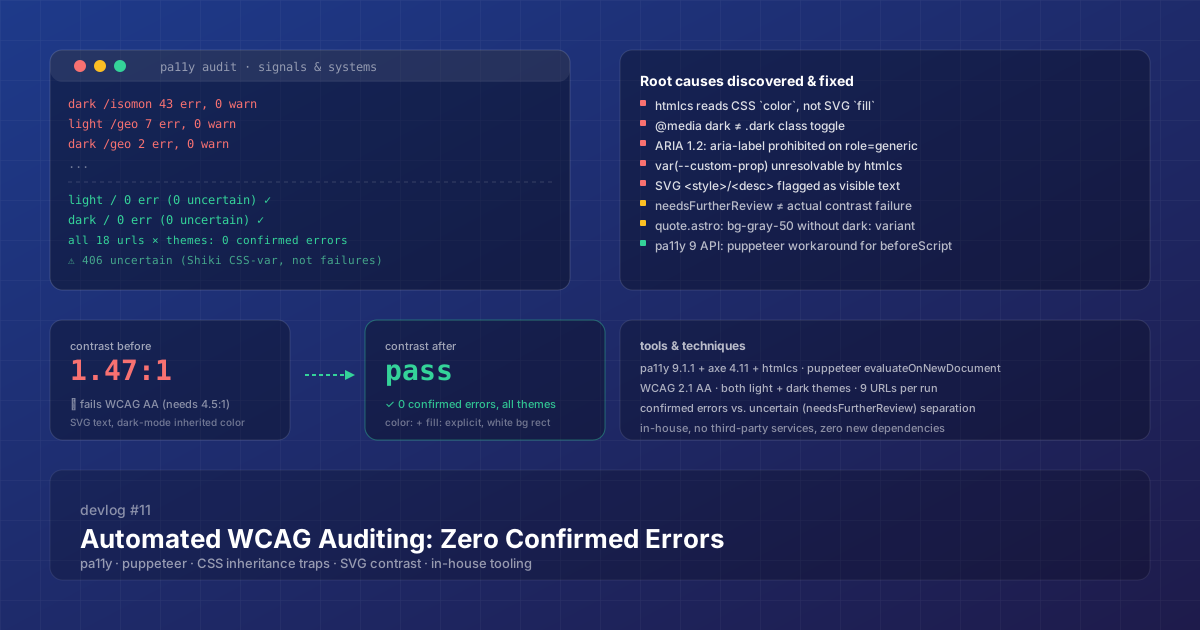
Devlog #10 established our accessibility aspirations and Lighthouse baseline. This installment is the engineering story: building an automated pa11y + puppeteer pipeline, then systematically eliminating every confirmed WCAG 2.1 AA failure across nine URLs × two themes, without adding a single new dependency or reaching for a third-party service.
Why Lighthouse Wasn’t Enough
Lighthouse gives a useful single-page snapshot. But Signals & Systems has eight distinct series/page types, a class-toggled dark mode, consent overlays, and a newsletter popup, all of which interact with contrast checkers in unexpected ways. A clean Lighthouse run on the homepage proves very little about an isomon article in dark mode.
The goal was a repeatable audit covering every content type, both themes, with overlays suppressed, and with a clear signal-to-noise separation between confirmed failures and uncertain items that tools can’t resolve.
Building the Pipeline
pa11y 9 and the Vanishing beforeScript
The first obstacle: pa11y 9 removed the beforeScript option. Previous versions let you inject JavaScript before page load to seed localStorage. The upgrade changelog mentioned it quietly, and our existing setup broke silently. The consent overlay was covering every page and causing false positives on elements rendered beneath its fixed, z-indexed overlay.
The fix: create our own Puppeteer browser and page, call evaluateOnNewDocument to seed the three keys before navigation, then pass the browser and page instances to pa11y via the browser and page options.
const browser = await puppeteer.launch({
args: ['--no-sandbox', '--disable-setuid-sandbox'],
});

// For each URL:
const page = await browser.newPage();
await page.evaluateOnNewDocument((t) => {
try {
  localStorage.setItem('ss-theme', t);               // light | dark
  localStorage.setItem('ss-analytics-consent', 'denied');
  localStorage.setItem('ss-newsletter-popup', JSON.stringify({
    closed: true, closedUntil: 9999999999999, minimized: false,
  }));
} catch (_) {}
}, theme);

const result = await pa11y(url, {
standard: 'WCAG2AA',
runners: ['axe', 'htmlcs'],
browser,
page,
timeout: 45000,
wait: 500,
});
This seeds localStorage for theme, consent, and popup state before a single byte of page JavaScript runs. The theme key drives the pre-hydration script that toggles .dark on <html>, so axe and htmlcs see the correct computed colors for both themes.
Separating Confirmed Errors from Uncertain Items
Axe 4.11 introduced needsFurtherReview: true on contrast findings where it cannot resolve CSS custom properties. Specifically: Shiki’s dual-theme approach emits --shiki-light and --shiki-dark CSS variables on every code token. Our activation rules in global.css switch between them based on the .dark class, but axe cannot evaluate var(--shiki-light) at runtime.
These are not genuine WCAG failures; the actual rendered colors pass with margin. But if we counted them naively, every page with code blocks would show dozens of “errors” that aren’t errors. The audit script filters them:
const confirmedErrors = errors.filter(
(i) => !i.runnerExtras?.needsFurtherReview
);
const uncertainErrors = errors.filter(
(i) => i.runnerExtras?.needsFurtherReview
);
The summary table outputs separate columns. Exit code uses only confirmedErrors.length. This kept the signal clean: every “confirmed error” in the report was a real problem we needed to fix.
The Bugs We Found
1. htmlcs Reads CSS color, Not SVG fill
The isomon article embeds a WiringSchematic component, an SVG wiring diagram. Initial audit showed 43 confirmed errors from it in dark mode, all WCAG2AA.Principle1.Guideline1_4.1_4_3.G18.Fail with a reported ratio of 1.47:1.
The SVG text elements used .component-text, .component-label, .pin-label CSS classes with explicit fill: #1f2937. That’s a very dark color; it should pass on the white SVG background. What was happening?
htmlcs computes contrast by calling getComputedStyle(element).color, the CSS color property, not SVG fill. In dark mode, .dark .prose p { color: #d1d5db } is inherited by every descendant of .prose, including SVG <text> elements. So htmlcs was seeing #d1d5db (light gray) on a white SVG background: 1.47:1.
The fix was two-part:
- Add an explicit white background
<rect>as the first child of the SVG so contrast checkers see a white background regardless of DOM context. - Add
color: #1f2937(mirroringfill) to every SVG text class, so the CSScolorproperty is explicitly set and not inherited from the dark-mode prose rules.
.component-text {
fill: #1f2937;
color: #1f2937; /* mirrors fill, prevents dark-mode .prose color inheritance */
font-family: system-ui, sans-serif;
font-size: 12px;
font-weight: 500;
}
.pin-label {
fill: #1f2937;
color: #1f2937;
font-family: system-ui, sans-serif;
font-size: 9px;
}
Insight
The pattern to remember: whenever you embed SVG inline inside a .prose container with dark mode, any <text> element without explicit CSS color will inherit the dark-mode prose text color. That inherited value is what contrast checkers see, not your SVG fill. Mirror fill with color on every SVG text class.
2. SVG <style> and <desc> Are Not Rendered Text (But htmlcs Checks Them)
After fixing the SVG text contrast, two errors remained in dark/isomon: the <style> element inside <defs> and the <desc> element. htmlcs was computing contrast on the text content of the CSS inside <style> and the description string inside <desc>. Neither of these is ever rendered visually.
This is an htmlcs bug; both elements are defined as non-rendered by the SVG spec. The pragmatic fix: move the SVG CSS out of the inline <style> block and into global.css (so no inline <style> element exists in the SVG), and add svg desc { display: none; } so htmlcs stops evaluating the description text as visible content.
The aria-labelledby reference to <desc> still works: per ARIA 1.1 §5.2.7.5, referenced elements are included in accessible name computation even when display: none.
3. @media (prefers-color-scheme: dark) ≠ .dark Class Toggle
CitationList.astro styled its links using a scoped @media (prefers-color-scheme: dark) block. Signals & Systems uses class-based dark mode: the .dark class is toggled on <html> via localStorage and a pre-hydration script. The media query never fires when the user sets dark mode through our toggle.
Result: in dark mode, citation list links stayed at their light-mode color (#6366f1, indigo-500) against the dark page background, hitting 3.86:1 and failing WCAG AA.
Two changes:
- Light mode fix:
#6366f1→#4f46e5(indigo-600), giving 5.8:1 on white. - Dark mode fix: add
.dark .demure-citation-list a { color: #a78bfa }toglobal.css, bypassing the broken media query entirely.
Warning
Watch for this pattern: any component that uses @media (prefers-color-scheme: dark) for styling will be invisible to class-based dark mode. All dark mode overrides need to use the .dark ancestor selector. Scoped Astro component styles can’t target parent-class selectors, so the fix lives in global.css.
4. CSS Custom Properties Are Opaque to htmlcs
StatsDisplay.astro styled its source attribution links with color: var(--stat-color), where --stat-color is an inline custom property set per stat item (#3B82F6, #8B5CF6, etc.). htmlcs cannot evaluate CSS custom properties; it sees an unresolvable value and falls back, producing a spurious low-contrast reading.
Even if htmlcs could resolve them, several default stat colors (emerald-500 #10B981, orange-500 #F97316) fail WCAG AA on white anyway.
Fix: hardcode accessible colors for the source link, independent of the accent color:
.stat-source a {
/* Hardcoded: htmlcs cannot resolve var(--stat-color),
   and some accent colors fail AA on white regardless.
   blue-700 achieves 6.2:1 on white. */
color: #1d4ed8;
}

:global(.dark) .stat-source a {
color: #93c5fd; /* blue-300, 7.3:1 on gray-900 */
}
5. ARIA 1.2: aria-label Is Prohibited on role="generic"
CodeBlock.astro had aria-label="Filename: {filename}" on a wrapper <div>. Two bugs in one attribute:
{filename}was a literal string, not an Astro expression; it rendered as"Filename: {filename}".- In ARIA 1.2, plain
<div>elements have implicit rolegeneric, which prohibitsaria-label(axe rule:aria-prohibited-attr).
Fix: remove the aria-label entirely. The filename is visible as text in the <div class="code-filename"> child, which is sufficient for screen readers without redundant labeling.
6. Missing Dark Variant on quote.astro Background
quote.astro had bg-gray-50 with no dark:bg-* variant. In dark mode, the text was dark:text-gray-200 (#e5e7eb) on the untouched bg-gray-50 (#f9fafb): 1.21:1.
Fix: add dark:bg-gray-800 dark:border-gray-500. Simple, but easy to miss without automated testing.
7. The Audit Said “Clean” But the Code Blocks Were Illegible
After landing all six fixes above, the audit reported zero confirmed errors. Then the first manual look at a devlog in light mode: code blocks were unreadable. Light gray text on a slightly-less-light gray background. How did the audit miss this?
Astro 5 changed the class name on Shiki’s <pre> element from astro-code (Astro 4) to shiki. The dual-theme activation rules in global.css still targeted .astro-code:
/* This selector never matches Astro 5 output. */
.astro-code,
.astro-code span {
color: var(--shiki-light) !important;
background-color: var(--shiki-light-bg) !important;
}
With the activation rules silent, code tokens had no color set. They inherited from the typography plugin’s .prose pre code rule, which sets a light gray meant for dark pre backgrounds. Light text on light bg.
The audit missed it for a subtle reason. Axe sees var(--shiki-light) in the cascade and emits needsFurtherReview for any element where it cannot resolve a CSS custom property, regardless of whether the rule actually applies. We filtered all needsFurtherReview items as “uncertain”. The selector was broken, the rules never fired, but axe still saw the unresolvable variable in the cascade and flagged the spans as uncertain rather than as confirmed failures.
The fix was a one-line selector update:
.astro-code,
.astro-code span,
.shiki,
.shiki span {
color: var(--shiki-light) !important;
background-color: var(--shiki-light-bg) !important;
}
The lesson is sharper than the fix. needsFurtherReview filtering is correct only when the rules involving CSS variables actually apply. If they silently don’t, the filter hides the real failure. When CSS-var activation is involved, manual visual verification is non-negotiable. The audit pipeline now has a Playwright verification step planned, but the durable lesson is to render every component variant in a real browser before declaring an audit clean.
8. High-Contrast Shiki Themes for Comment Tokens
Once activation worked, axe could resolve the actual rendered colors and immediately surfaced 26 new dark-mode failures: code-block comments. The github-light and github-dark Shiki themes both use #6A737D for comment tokens, which is 3.5:1 on the dark #24292e background, well below WCAG AA’s 4.5:1 floor.
Two Shiki instances had to change. Astro processes fenced code blocks via the config in astro.config.mjs, but the <CodeBlock> component runs its own Shiki instance in src/utils/codeHighlight.ts. Both moved to the high-contrast variants:
shikiConfig: {
themes: {
  light: 'github-light-high-contrast',
  dark: 'github-dark-high-contrast'
},
defaultColor: false
}
Comment tokens went from #6A737D to #66707B on light (4.86:1) and #BDC4CC on dark (~11.6:1). Every other token already passed.
The Audit Results
After every fix above, including the Astro 5 selector unmask and the high-contrast theme switch, the audit reports zero confirmed WCAG 2.1 AA errors across all nine routes in both light and dark mode (18 audit invocations in total). The roughly 320 remaining items are flagged by axe as “needs further review” because they reference Shiki’s --shiki-light / --shiki-dark CSS variables that axe cannot resolve at runtime. The variables resolve to the high-contrast theme colors in the browser, all of which pass WCAG AA, so these are uncertainty in the tool, not failures in the page.
Reviewing With Bots: The Branch + PR Workflow
The audit pipeline only catches what it knows to look for. Some of the most useful catches in this work came from reading code, not running it. Now that the WCAG zero-error baseline is real, all non-trivial work goes through a branch + PR workflow with both Copilot and Codex set as automatic reviewers via a small workflow that calls the GitHub requested_reviewers API on every PR open. The CI gates (typecheck, content validation, accessibility audit) are now blocking via a branch-protection ruleset, so a regression that breaks any of them blocks the merge before it reaches main.
The very first PR through this workflow (#3, the one that introduced the audit pipeline itself) caught five real issues that the audit could never have found:
puppeteer.launchoutsidetry/finally: if Chrome download or system-deps initialization fails, the http-server leaks. Restructured to a single outer try withbrowserdeclaredlet nulland closed in finally..prose :where(code)clobbered Shiki block tokens: the inline-code styling rule also matchedpre > codefrom Shiki blocks, fighting with the new high-contrast backgrounds. Added:not(pre *)to the negation list.- Generic SVG class names in
global.css:.wire,.component-text,.pin-labelwere unscoped and could collide with future non-SVG content. All scoped to.wiring-schematic-container. svg desc { display: none }was site-global: the rule meant to suppress an htmlcs false positive on one schematic was hiding<desc>-based labelling on every SVG. Scoped to.wiring-schematic-container svg desc.- CitationList dark-mode override missed by specificity:
.dark .demure-citation-list a(specificity 0,2,1) couldn’t beat the scoped.demure-citation-list[data-cid] a[data-cid]rule (specificity 0,3,2). Moved the override into the component’s own scoped style block as:global(.dark) .demure-citation-list a, picking up the same data-cid scoping and winning cleanly.
None of these would fail axe. None would block a contrast assertion. They are correctness, scoping, and lifecycle issues, the kind of things a reviewer notices and a static analyzer doesn’t.
Closing the Gap Between Claims and Reality
After the audit landed, a manual read of the accessibility statement against the codebase turned up another category of issue: claims on the page that the code did not quite back up. The audit was happy because every rendered page passed automated checks, but several of the assertions about what was in place were partially aspirational. Closing those gaps was its own short-but-pointed pass:
- The “ESC and outside-click close the consent dialog” claim was half-true: ESC worked, outside-click on the backdrop did not. Added a backdrop click handler that maps to the same decline-and-close action as ESC, so the two dismissal paths behave identically.
- The “outside-click closes the mobile menu” claim was true, but unlike ESC it did not restore focus to the trigger. The first attempt unconditionally called
mobileMenuButton.focus()on outside-click, which a Copilot review flagged: when the user clicks an interactive element outside the menu, focus has already moved to that element, and stealing it back overrides their intent. The final implementation only restores focus when keyboard focus was still inside the menu (or on the trigger) at click time. Mouse-driven outside-clicks on a different link or button leave that element focused; keyboard-driven dismissal lands the user back on the trigger. - “Visible focus-visible rings on every interactive control” was overstated. Most components used Tailwind’s
focus:prefix, which fires on both keyboard and mouse focus, rather thanfocus-visible:, which fires only when the browser believes a keyboard interaction is in progress. A site-wide migration converted everyfocus:outline-none,focus:ring-*, andfocus:border-blue-*to itsfocus-visible:counterpart so rings only show when they are useful, not on every click. - “Charts expose an SR-only data table and an
aria-label” was true for the general-purposeChartComponent, but the seven other chart variants (HeatmapChart,RadarChart,SankeyChart,ScatterChart,TimelineChart,DataChart,ChartWithData) had none of it. Each wrapper now uses<figure role="group">witharia-labelledby/aria-describedby, sets anaria-labelon the rendered surface (<canvas>or D3 container), and emits ansr-onlydata table whose row/column structure matches the chart type (heatmap by axis crossing, sankey by source/target/value, scatter by series and coordinate, etc.). - The wiring-schematic component shipped with a “View connection list”
<details>element, but the slot it exposed for the data table was unfilled in production usage, so readers saw an apologetic “a textual equivalent is not yet wired up” fallback. The single live schematic now passes a populated table (from-pin, to-pin, signal type) through the slot, and the fallback message has been rewritten so future schematics that omit the slot describe themselves rather than apologize.
The accessibility statement at /accessibility was rewritten alongside these fixes to match what the code now does, claim by claim.
Design Principles Applied
Every fix followed the same philosophy: in-house, lightweight, documented.
- No third-party accessibility SaaS subscriptions
- No new npm dependencies (pa11y and puppeteer were already present)
- Each fix is a targeted CSS or markup change with a comment explaining why
- The audit script is a single plain JS file in
scripts/: readable, hackable, no build step
The needsFurtherReview filter is the most important architectural decision, with the caveat learned the hard way: it’s only correct when the rules involving CSS variables actually apply. Combined with manual rendered-color verification on every variant, the filter keeps the signal clean.
What’s Next
The audit now runs in CI as a blocking gate on every pull request and on every push to main, alongside the typecheck and content validation gates. A regression in any of them blocks the GitHub Pages deploy. The accessibility statement at /accessibility reflects the audited state, no more “work in progress” or “known gaps” caveats.
Beyond keeping the gate green, two follow-ups are worth scoping: a Playwright check that asserts non-trivial contrast on rendered code blocks (so the next Astro version bump or theme swap can’t silently re-illegibilize them), and a per-instance unique ID for chart gradients so two charts on one page no longer collide on #gradient-0. Both are graceful-degradation issues, not WCAG failures, but the kind of housekeeping that pays off when you next touch the code.
References

JELL is an innovator, educator, and technologist exploring the confluence of AI, higher education, and ethical technology. Through Signals & Systems, JELL shares insights, experiments, and reflections on building meaningful digital experiences, and other random things.